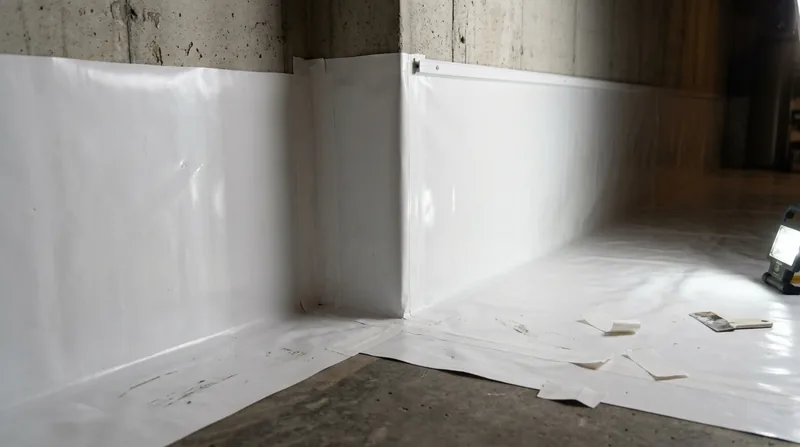




If your Durham basement smells musty after a wet week or the block walls sweat through the summer, you are dealing with ground moisture vapor, not a plumbing leak. Vapor Barrier Installation in Durham puts a heavy-duty sheet across the walls and slab to stop that vapor at the source, with sealed seams, taped terminations, and sump integration where the floor drains. In a city built on red Piedmont clay and the heavy gray Triassic Basin clay that swells wet and shrinks dry, the moisture load under a slab never really stops. We work the older raised brick-pier cellars in Trinity Park and Watts-Hillandale and the poured walkouts stepping down the Chapel Hill and Carrboro hills, and the fix is different for each. Call (984) 329-0255 to schedule a free basement inspection. For the full scope of what we do below grade, see our basement waterproofing service.
Why vapor barriers matter in Durham's clay and humid summers
Durham sits in a humid pocket where summer dew points stay high and the clay under most homes holds water for days after a storm. That moisture moves through concrete and block as vapor, not liquid, so a wall can look dry while the basement stays damp. Sealing the surface alone traps the vapor, which is why a proper sheet with sealed seams and a drainage path matters more than paint.
- Triassic Basin clay swells when wet and shrinks when dry, opening hairline paths for vapor under slabs and footings.
- Old mill houses in Walltown and Old West Durham sit on low piers where ground moisture rises straight into the joists and subfloor.
- 1950s to 1970s brick ranches around Hope Valley and Northgate Park have shallow lower levels that stay humid long after the rain stops.
- Hillside walkouts in Chapel Hill, Carrboro, and Hillsborough take runoff against the rear wall, and vapor follows that water load.
- Efflorescence on block walls is the visible sign that moisture is moving through the masonry and leaving salts behind.
A vapor barrier does not replace drainage. It works when the water table and hydrostatic pressure are already managed, and we tell you plainly when that is not yet the case.
Key info: A 1920s bungalow in Old North Durham on a raised brick-pier foundation often needs a wall-and-floor sheet tied into a sump basin, while a 1990s walkout in Hillsborough may only need the lower wall and slab covered where the hillside runoff loads the rear corner.
Local code questions about drainage alterations are handled by the City of Durham building department, and rules vary, so verify before work starts: City of Durham official site.
How we install a vapor barrier in a Durham basement
We start by finding where the moisture is actually coming from, because a barrier over an active leak just hides it. A free inspection covers the walls, the cove joint, the slab, the sump basin, and the grading outside. Then we map the sheet layout so seams land on solid material and terminations tuck behind the rim.
- We inspect the basement and foundation and note efflorescence, wall seepage, and any water after rain that points to hydrostatic pressure.
- We correct the water path first, which may mean an interior drain tile system or sump work before any sheet goes up.
- We clean and prep the walls and slab, then fasten the heavy-duty barrier with mechanical terminations, not adhesive alone.
- We seal every seam and tape the top and bottom terminations so vapor cannot escape behind the sheet.
- We integrate the barrier with the sump basin and discharge so the floor drains as designed.
- We walk the job with you and explain what to watch for in the first wet season.
If the walls are damp because of a crack rather than general vapor, we say so and point you to crack repair instead of selling a sheet you do not need.
Key info: On a split-level in Duke Park, we found the lower level humid because the slab edge met clay that stayed saturated. Sealing the cove joint and running the barrier into a sump basin fixed the humidity without touching the upper floor.
Vapor barrier approaches we use and when each fits
Not every Durham basement takes the same sheet and the same termination detail. The table below shows the approaches we install and the conditions each one suits, from a damp slab to a wall that weeps after every summer thunderstorm.
| Approach | Description | Best for |
|---|---|---|
| Wall and slab sheet with sealed seams | Heavy-duty barrier fastened to block or concrete walls, lapped and taped onto the slab. | Damp basements with efflorescence and a musty smell but no standing water. |
| Dimple board drainage plane | Studded membrane that holds the sheet off the wall and lets moisture drain to the footing. | Walls that weep after rain and need a path to the drain tile. |
| Sump-integrated floor barrier | Slab sheet terminated into the sump basin with a sealed collar and check valve clearance. | Basements with an existing sump pump or a planned one. |
| Targeted wall termination at the rim | Sheet tucked and taped behind the rim board on raised pier and block foundations. | Older bungalows and mill houses with shallow cellars. |
| Full perimeter with drainage correction | Barrier installed after drain tile or crack repair so vapor control sits on a dry wall. | Wet basements with hydrostatic pressure and active seepage. |
We choose the approach after the inspection, not before, because the wall tells us which one will hold.
Vapor Barrier Installation cost in Durham: what to expect
Most vapor barrier work in Durham starts around $3 per square foot of covered wall and floor, and the final number depends on how much prep the basement needs. A clean slab and dry block wall land near that starting figure. A wall that needs parging, a cove joint that needs sealing, or a sump collar that needs rebuilding moves the price up.
Access matters too. A shallow cellar under a 1920s bungalow in Forest Hills takes more labor than an open walkout in a 2000s home in south Durham, and a basement packed with stored items adds time to clear and protect. If the inspection shows hydrostatic pressure, the barrier is only part of the job and the drainage correction is priced separately.
Get two or three written estimates and compare what each one includes: seam sealing, terminations, sump integration, and disposal. A low number that skips the terminations is not the same job. Our full pricing overview lays out how we build a quote.
Vapor Barrier Installation near me: how to hire in the Durham area
When you search for vapor barrier installation near me, the contractor you pick should be able to explain why your basement is damp before quoting a sheet. Ask for the license and insurance certificate, and confirm the coverage is current for the company, not just the owner. Ask how they handle seams and terminations, because that detail separates a working barrier from a plastic sheet stapled to a wall.
- Confirm the company is licensed and insured and ask for the certificate before work begins.
- Get two or three estimates in writing and compare scope line by line, not just the total.
- Ask for references from Durham jobs with the same foundation type as yours.
- Ask who pulls any permit if the work alters drainage or the sump discharge connection, since the City of Durham building department sets the rules.
- Check HOA requirements if you live in a planned community around Chapel Hill or Hillsborough before scheduling.
A contractor who cannot answer these plainly is not the one to trust with a below-grade job. Reach us through our contact page to set up a free inspection.
When a vapor barrier is the right call and when it is not
A vapor barrier is the right answer when the basement is damp, the walls show efflorescence, and there is no standing water after a storm. It is the wrong answer when water is entering through a crack or the wall is bowing, because the sheet will trap moisture against a failing wall. In those cases we point you to crack repair or a structural repair first, then come back to vapor control once the wall is stable.
- Choose a barrier when the slab and walls are damp but dry to the touch between storms.
- Fix active seepage with crack repair or drainage before covering the wall.
- Address a bowing wall with structural repair before any sheet goes on.
- Pair the barrier with a working sump pump and a battery backup if the basement floods during power outages.
We tell you which case you are in during the inspection, and we do not sell a barrier over a problem it cannot solve.
Vapor Barrier Installation in Durham: Pricing Guide
| Service | Price | Details |
|---|---|---|
| Wall and slab vapor barrier | Starting at $3/sq ft | Includes heavy-duty sheet, sealed seams, taped terminations, and basic wall prep. |
| Dimple board drainage plane | Starting at $4/sq ft | Adds studded membrane and drainage path to the footing, priced by wall height. |
| Sump-integrated floor barrier | Starting at $3.50/sq ft | Includes sealed collar at the sump basin and clearance for the check valve. |
| Full perimeter with drainage correction | On estimate | Needs an on-site look because drain tile, crack repair, or parging may be required first. |
| Travel | Included | In Durham and surrounding areas, no separate call-out or mileage fee. |
| Estimate | Free | Response within 24h at (984) 329-0255, no obligation to book. |
Indicative pricing, the exact cost depends on square footage, finish, and site access. Free personalized estimate within 24h at (984) 329-0255.


